


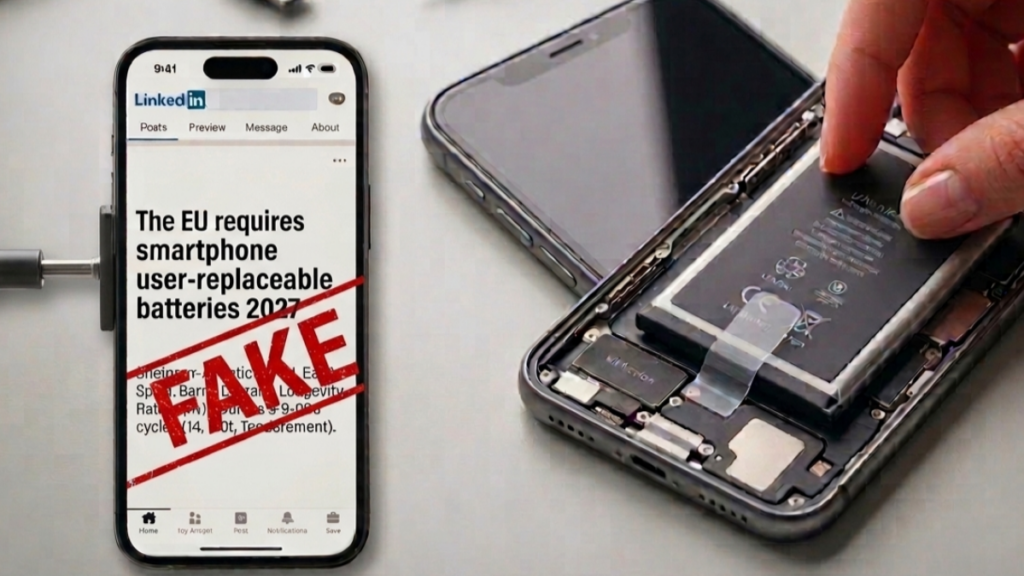
You may have seen posts circulating on LinkedIn and beyond claiming that the EU will soon impose a “new” requirement forcing smartphone makers to offer user-replaceable batteries, with 2027 cited as the deadline.
Let me set the record straight.
The claim going around
The narrative usually goes something like this:
"Big news: from 2027, the EU Battery Regulation 2023/1542 will require smartphones to have batteries that users can replace themselves. Manufacturers had better get ready."
It sounds like a significant future disruption. The problem is that it is largely wrong, on both the date and the framing of it being “new.”
What the regulation actually says
For smartphones specifically, the relevant legislation is not the Battery Regulation alone. It is Regulation (EU) 2023/1670, the Ecodesign Regulation for smartphones and tablets.
The specific requirement on removability and replaceability of the battery has been applicable since 20 June 2025.
Article 5(1)(c) Disassembly requirements states:
(c) From 20 June 2025, manufacturers, importers or authorised representatives shall ensure that the process for battery replacement: (i) meets the following criteria:
— fasteners shall be resupplied or reusable;
— the process for replacement shall be feasible with no tool, a tool or set of tools that is supplied with the product or spare part, or basic tools;
— the process for replacement shall be able to be carried out in a use environment;
— the process for replacement shall be able to be carried out by a layman.
This is not a future ambition. It is current law.
What about the Battery Regulation?
The EU Battery Regulation (2023/1542) does address removability and replaceability requirements for products that incorporate portable batteries in Articl 11. But it also acknowledges other regulations that might provide more stringent requirements, such as Regulation 2023/1670 for smartphones and tablets.
The two regulations work together, not in competition.
Why does this matter?
Because the “coming in 2027” framing creates a false sense of runway.
If you work in product compliance, hardware design, supply chain, or consumer electronics, your roadmap needs to reflect the current state of the law, not a misread of it. Devices placed on the EU market from 20 June 2025 onwards must already meet these requirements.
And these requirements are substantive. A user must be able to replace their battery:
- Without specialist tools: basic tools, or those supplied with the device, are sufficient
- In a normal environment: not a repair shop
- As a layman: no technical expertise required
This is a meaningful design constraint. It affects fasteners, adhesives, back panel construction, modularity, and the overall repairability philosophy of a device.
The bigger picture: Right to Repair
This rule does not exist in isolation. It is part of a broader EU push toward the right to repair, giving consumers more control over the products they own, extending device lifespans, and reducing electronic waste.
Regulation 2023/1670 also covers other repairability requirements beyond batteries: spare parts availability, software updates, and disassembly instructions, among others. Battery replaceability is one piece of a larger legislative shift that is already reshaping how devices must be designed for the European market.
We are here to help
At RoHSorNot, we help manufacturers and importers comply with the requirements of these and other regulations and directives.
Contact us at: contact@rohsornot.com and get in contact with us.
Sources: Regulation (EU) 2023/1670 of the European Parliament and of the Council; Regulation (EU) 2023/1542 (Battery Regulation), Article 11.
